<?xml version="1.0" encoding="utf-8"?><feed xmlns="http://www.w3.org/2005/Atom" ><generator uri="https://jekyllrb.com/" version="3.10.0">Jekyll</generator><link href="http://beachwood23.com/feed.xml" rel="self" type="application/atom+xml" /><link href="http://beachwood23.com/" rel="alternate" type="text/html" /><updated>2026-07-25T14:22:37+00:00</updated><id>http://beachwood23.com/feed.xml</id><title type="html">beachwood23.com</title><subtitle>Your new favorite blog.</subtitle><author><name>beachwood23</name></author><entry><title type="html">Who wins in Ukraine?</title><link href="http://beachwood23.com/2022/03/28/thoughts-russia-ukraine.html" rel="alternate" type="text/html" title="Who wins in Ukraine?" /><published>2022-03-28T00:00:00+00:00</published><updated>2022-03-28T00:00:00+00:00</updated><id>http://beachwood23.com/2022/03/28/thoughts-russia-ukraine</id><content type="html" xml:base="http://beachwood23.com/2022/03/28/thoughts-russia-ukraine.html"><![CDATA[<p>The whole situation is awful and depressing. Russia is making an aggressive, violent move, that has a chance of escalating in nuclear war. But why are they doing this?</p>

<p>Ukraine was close to joining NATO. <a href="https://fair.org/home/what-you-should-really-know-about-ukraine/">This has been the goal of US policy in Ukraine for years</a>, and is why the <a href="https://www.commondreams.org/newswire/2014/03/18/ukraine-and-national-endowment-democracy-form-intervention">National Endowment for Democracy funded the ukrainian coup / revolution in 2014</a>, so that their handpicked man, sympathetic to Europe / EU / NATO / US, could be placed in power. It is also why <a href="https://www.theguardian.com/world/2004/nov/26/ukraine.usa">the US funded pro-American political parties in the 2004 election</a> – manipulating voters in Ukraine and steering them towards conflict with their Russian neighbor.</p>

<p>That happened, and Russia feels even more strongly now that they need a buffer from NATO, which is not so much a defensive organization anymore, but a growing and aggressive organization. So, they take the areas they can, claiming that they are supporting ethnically-Russian seperatists in Ukraine. As the FAIR article above says:</p>
<blockquote>
  <p>From Russia’s point of view, a longtime adversary had successfully overthrown a neighboring government using violent far-right extremists.</p>
</blockquote>

<blockquote>
  <p>The Crimean peninsula—82% of whose households  <a href="https://pdf.usaid.gov/pdf_docs/pnaec705.pdf">speak Russian</a> , and only 2% mainly Ukrainian—held a plebiscite in March 2014 on whether or not they should join Russia, or remain under the new Ukrainian government. The Pro-Russia camp won with 95% of the vote. The UN General Assembly, led by the US, voted to  <a href="https://www.cfr.org/interview/why-crimean-referendum-illegitimate">ignore the referendum results</a>  on the grounds that it was contrary to Ukraine’s constitution.</p>
</blockquote>

<p>This balance of Russian and NATO power in Ukraine has been shaky for some time. It has been discussed that it might lead to war, by many people, such as  <a href="https://www.youtube.com/watch?app=desktop&amp;v=JrMiSQAGOS4">Professor John Mearsheimer back in 2015.</a></p>

<h2 id="what-i-think-will-happen-in-the-near-term">What I think will happen in the near term</h2>
<p>Ukraine will either fall to the Russians, or perhaps Russia will leave as a shattered, broken country, and let NATO pick up the pieces. A Ukrainian president’s advisor <a href="https://twitter.com/SDyorin/status/1503626407309713411?s=20&amp;t=qk34-wCB7M9v4MTLoRs--Q">stated just this, back in 2019.</a></p>

<p>The above tweet now appears deleted. Thankfully, I archived it and saved it for safekeeping. It is here:</p>
<video controls="" width="500" src="/assets/1503626407309713411.mp4" type="video/mp4">
</video>

<blockquote>
  <p>With a probability of 99.9%, our price for joining NATO is a big war with Russia. And if we do not join NATO, it is absorption by Russia within 10 to 12 years.</p>
</blockquote>

<p>We pushed Russia to the breaking point, and now we get to see what plays out.</p>

<p>It is doubtful that we will directly intervene in Ukraine – this would escalate the situation by making US troops fight Russian troops, and directly lead to WW3.</p>

<p>Russia will be exiled on the Western stage (basically America / EU aligned countries). Exiled means economic sanctions and no movement of citizen’s money to the West. Gas and oil will be drastically more expensive for EU and for the US.</p>

<p>America will take the “win” of seeing the Western empire align against Russia. Russia will become much economically closer with China, and potentially Africa (much of Africa has been turning to Chinese investment over the past twenty years). Do they also become closer to other countries that are facing extreme sanctions from the West and are “almost” exiled, like Iran, Pakistan, Venezuela, Cuba, etc? Perhaps we are seeing the concrete formation of the next world war’s “Axis” powers.</p>

<h2 id="who-wins-economically">Who wins economically?</h2>
<p>This one is interesting. Russia will struggle economically for a while. But so will Europe and the US.</p>

<p>The US is still recovering from a recession and the consequent inflation. The Federal Reserve has needed to raise interest rates, to stop inflation growth. Now, debt will be more expensive in the future. But energy prices will continue to rise because we aren’t including Russia’s sales to Europe – their energy needs will stay the same, pushing up the price of energy in the Western markets. Expensive energy that is increasing in cost means that the cost of goods will continue to rise, e.g. we will have even more inflation.</p>

<p>Soon we will have both expensive debt <em>and</em> still high inflation. What a dangerous combination. I’m not sure how we get out of that situation.</p>

<p><a href="https://news.ycombinator.com/item?id=30457490">Ukraine supplies 90% of “US semiconductor grade neon” gas</a>. So <a href="https://www.reuters.com/breakingviews/ukraine-war-flashes-neon-warning-lights-chips-2022-02-24/">computer chips will become even more expensive</a> than they are now. Is the US prepared for more years of expensive chips holding back basic production and car production? No, we are not. Intel is still years away from bringing large scale chip fabrication back to the states.</p>

<p>China will be getting an easy win. Russia’s economy will be struggling, as their energy exports aren’t being purchased in the Western markets. China can step in and provide a lifeline to Russia by purchasing their energy exports, while still getting a cut value price as the ruble has collapsed.</p>

<p>This will also weaken the global demand for the dollar. China and Russia will become close trading partners for energy and other goods – none of which will be traded in the US dollar. Other countries that wish to continue trading with China (which is all of the countries. The world is too dependent upon China to stop trading now) might be pressured to also trade in non-US currency.</p>

<p>The US and the West lose economically, Russia also struggles in the short term, but China is a clear winner.</p>

<h2 id="who-wins-politically">Who wins politically?</h2>
<p>Politics often follow economics, but not always.</p>

<p>The “West” is known as the “West” because of our shared history that makes Western culture similar. Philosophies of individualism descending from Greek wisdom, peoples following Judeo-Christian religions – these things help define what it means to be a “Western” country.</p>

<p>But this does not mean that all “Western” countries are fated to get along. I think that the US has overstepped its role in policing NATO / EU, and there will be tremendous amounts of political resentment. We orchestrated this pressure pot, added heat until the situation boiled over, and it will be the EU who is left to deal with most of the fall out.</p>

<p>We have damaged our relationship with the rest of NATO and with the EU.</p>

<p>Additional note: The US has broken its unspoken pact with the West and being the world police. The deal was that the US could do whatever it wanted, acting unilaterally to protect its interests, and NATO / Europe wouldn’t have to worry about war on their home fronts. The US has antagonized Russia and invited an invasion of a country in Europe, and I don’t think this will help our long-term relationship with Europe.</p>]]></content><author><name>beachwood23</name></author><summary type="html"><![CDATA[The whole situation is awful and depressing. Russia is making an aggressive, violent move, that has a chance of escalating in nuclear war. But why are they doing this?]]></summary></entry><entry><title type="html">Top premier league players of 2015</title><link href="http://beachwood23.com/2016/01/18/top-premier-league-players.html" rel="alternate" type="text/html" title="Top premier league players of 2015" /><published>2016-01-18T00:00:00+00:00</published><updated>2016-01-18T00:00:00+00:00</updated><id>http://beachwood23.com/2016/01/18/top-premier-league-players</id><content type="html" xml:base="http://beachwood23.com/2016/01/18/top-premier-league-players.html"><![CDATA[<p>The Guardian newspaper recently released its <a href="http://www.theguardian.com/football/ng-interactive/2015/dec/21/the-100-best-footballers-in-the-world-2015-interactive">list of the Best 100 Footballers in the World</a>. These players often have tremendous impact on games, capable of going against the run of the game and changing the result on their own. Strikers might make wonder shots, midfielders an incisive pass requiring tremendous vision, keepers a one-handed save. How much money does it cost each team in the Premier League to get one of these special players?</p>

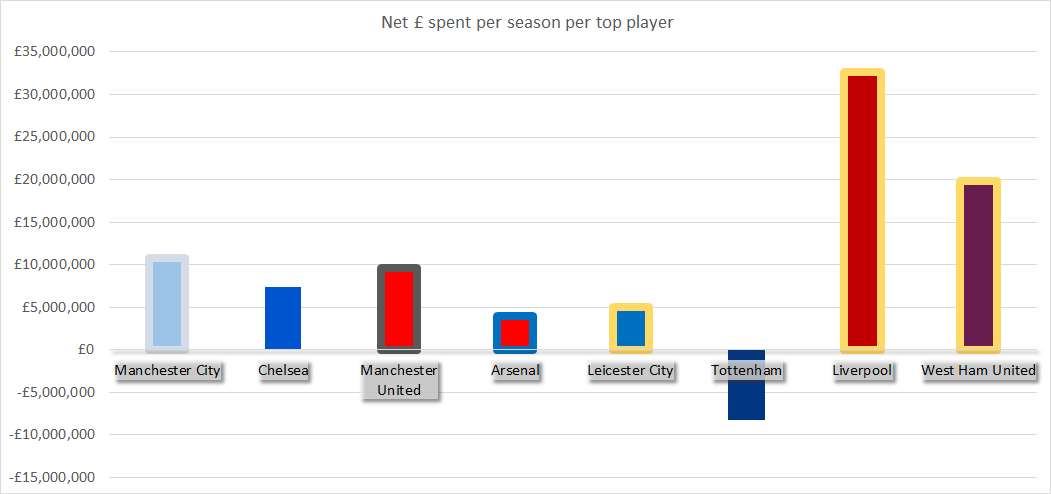
<p>Given the rising cost of players, how efficiently a club spends in the transfer market can have a tremendous effect on their squad. Obviously, each team will want to have the most top footballers at the lowest cost. Over the past 5 years, most British clubs have a net (net = buys - sales) spend of between £10-5 million for each top footballer. Tottenham has been especially prudent, developing the talents of Harry Kane while making a profit over the past five years. Liverpool has been the most foolish spender, with an net outlay of £32 million per season and only one top player, Coutinho, to show for it. To most Premier League followers, this won’t be surprising. Tottenham, with Daniel Levy as its head, is known as a shrewd club and a disciplined buyer. In contrast, Liverpool and its infamous Transfer Committee have been under inquiry for the past few years – rightly so, as we can see in the below charts. Liverpool have a higher net spend per season than Arsenal, yet their squad has 1 top footballer to Arsenal’s 5. Liverpool’s wages cost 30% more than Tottenham’s, yet we have arguably worse depth and game-changers than their squad. </p>

<p>Fenway Sports Group, owners of Liverpool, have not shied away from their fiduciary responsibilities. They’ve provided Liverpool enough funds to make them the third-highest net spender over the past 5 years, and the fifth-highest yearly wage bill. Unfortunately, poor transfer business has wasted all their intent and ambition, leaving Liverpool arguably the worst spender in the Premier League over the past 5 years. </p>

<p>Other notes:</p>

<ul>
  <li>Arsenal have just one less top player than the Big 3 (the Manchester clubs and Chelsea), but only needed to spend near 4million pounds per top player, compared to an average of around 9million pounds for the other clubs.</li>
  <li>West Ham is the second most wasteful club, spending £19 million to acquire their one top player, Dimitri Payet.</li>
  <li>Of the clubs with 6 top footballers, Chelsea has been the most efficient spender.</li>
  <li>Leicester has done amazingly, with a wage bill only 45% as large as Tottenham’s (and 33% of Liverpool’s) while amassing two top footballers.</li>
</ul>

<p><img src="/images/netspend.png" alt="" /></p>

<p><img src="/images/netspendperplayer.png" alt="" /></p>

<p><img src="/images/wages.png" alt="" /></p>

<table>
  <thead>
    <tr>
      <th>Team</th>
      <th>Players in TheGuardian’s Top 100 Footballers</th>
      <th>Net spend per season</th>
      <th>Season £ spent per top player</th>
      <th>2015/16 Wages</th>
    </tr>
  </thead>
  <tbody>
    <tr>
      <td>Manchester City</td>
      <td>6</td>
      <td>£64,480,000</td>
      <td>£10,746,667</td>
      <td>£193,800,000</td>
    </tr>
    <tr>
      <td>Chelsea</td>
      <td>6</td>
      <td>£44,041,800</td>
      <td>£7,340,300</td>
      <td>£215,600,000</td>
    </tr>
    <tr>
      <td>Manchester United</td>
      <td>6</td>
      <td>£57,660,000</td>
      <td>£9,610,000</td>
      <td>£203,000,000</td>
    </tr>
    <tr>
      <td>Arsenal</td>
      <td>5</td>
      <td>£19,805,000</td>
      <td>£3,961,000</td>
      <td>£192,000,000</td>
    </tr>
    <tr>
      <td>Leicester City</td>
      <td>2</td>
      <td>£10,030,000</td>
      <td>£5,015,000</td>
      <td>£48,200,000</td>
    </tr>
    <tr>
      <td>Tottenham</td>
      <td>1</td>
      <td>-£8,240,000</td>
      <td>-£8,240,000</td>
      <td>£110,500,000</td>
    </tr>
    <tr>
      <td>Liverpool</td>
      <td>1</td>
      <td>£32,666,000</td>
      <td>£32,666,000</td>
      <td>£152,000,000</td>
    </tr>
    <tr>
      <td>West Ham United</td>
      <td>1</td>
      <td>£19,850,000</td>
      <td>£19,850,000</td>
      <td>£69,500,000</td>
    </tr>
  </tbody>
</table>

<p>Sources:</p>

<p>From <a href="http://www.transferleague.co.uk/premier-league-last-five-seasons/transfer-league-tables/premier-league-table-last-five-seasons">http://www.transferleague.co.uk/premier-league-last-five-seasons/transfer-league-tables/premier-league-table-last-five-seasons</a>, grabbed net spend of each club, over the past 5 seasons. So, essentially, the net cost to build the current squad.</p>

<p>From <a href="http://www.totalsportek.com/money/english-premier-league-wage-bills-club-by-club/">http://www.totalsportek.com/money/english-premier-league-wage-bills-club-by-club/</a>, obtained wage bills of each club, for 2015/16.</p>]]></content><author><name>beachwood23</name></author><summary type="html"><![CDATA[The Guardian newspaper recently released its list of the Best 100 Footballers in the World. These players often have tremendous impact on games, capable of going against the run of the game and changing the result on their own. Strikers might make wonder shots, midfielders an incisive pass requiring tremendous vision, keepers a one-handed save. How much money does it cost each team in the Premier League to get one of these special players?]]></summary></entry><entry><title type="html">Automating the creation of posts in Jekyll</title><link href="http://beachwood23.com/2014/06/11/automating-the-creation-of-posts-in-jekyll.html" rel="alternate" type="text/html" title="Automating the creation of posts in Jekyll" /><published>2014-06-11T00:00:00+00:00</published><updated>2014-06-11T00:00:00+00:00</updated><id>http://beachwood23.com/2014/06/11/automating-the-creation-of-posts-in-jekyll</id><content type="html" xml:base="http://beachwood23.com/2014/06/11/automating-the-creation-of-posts-in-jekyll.html"><![CDATA[<p>I like to automate things that are a bit tedious. So, I’ve automated a slightly tedious thing and probably put more time into than will pay off. But perhaps it might help someone else.</p>

<p>To make a post, you put a new file in the <code class="language-plaintext highlighter-rouge">_posts/</code> directory. This file must be named strictly in the form of <code class="language-plaintext highlighter-rouge">"yyyy-mm-dd-post-title.md"</code>. Once the file is created, a header is required of the following form:</p>

<figure class="highlight"><pre><code class="language-bash" data-lang="bash"><span class="nt">---</span>
layout: post
title: Automating the Creation of Posts <span class="k">in </span>Jekyll
<span class="nt">---</span></code></pre></figure>

<p>This is all stuff that I want created for me – the computer knows the date, right? Why do I have to type that in? And once I declare the title of the post once, why should I type that again?</p>

<p>Obviously I’m just lazy. So, I wrote the ugliest Ruby code you’ve ever seen to automate the post-file creation.</p>

<figure class="highlight"><pre><code class="language-ruby" data-lang="ruby"><span class="c1">#!/usr/bin/ruby</span>

<span class="c1"># introduce ourselves</span>

<span class="k">def</span> <span class="nf">greet</span>
  <span class="nb">puts</span> <span class="s2">"** rywhite's Postmaker - a Jekyll blog post Generator **"</span>
<span class="k">end</span>


<span class="c1"># get post title from user</span>
<span class="k">def</span> <span class="nf">getPostTitle</span>
  <span class="nb">print</span> <span class="s2">"Post title: "</span>
  <span class="n">title</span> <span class="o">=</span> <span class="nb">gets</span>
  <span class="k">return</span> <span class="n">title</span>
<span class="k">end</span>

<span class="c1"># construct file name</span>

<span class="k">def</span> <span class="nf">buildFileName</span><span class="p">(</span><span class="n">title</span><span class="p">)</span>
  <span class="n">fileTitle</span> <span class="o">=</span> <span class="n">title</span><span class="p">.</span><span class="nf">downcase</span> <span class="c1"># convert all letters to lower case</span>
  <span class="n">fileTitle</span> <span class="o">=</span> <span class="n">fileTitle</span><span class="p">.</span><span class="nf">strip</span> <span class="c1"># remove all leading or trailing whitespace</span>
  <span class="n">fileTitle</span> <span class="o">=</span> <span class="n">fileTitle</span><span class="p">.</span><span class="nf">gsub</span><span class="p">(</span><span class="s1">' '</span><span class="p">,</span> <span class="s1">'-'</span><span class="p">)</span> <span class="c1"># convert spaces to dashes</span>
  <span class="n">fileTitle</span> <span class="o">=</span> <span class="n">fileTitle</span><span class="p">.</span><span class="nf">gsub</span><span class="p">(</span><span class="sr">/[^\w-]/</span><span class="p">,</span> <span class="s1">''</span><span class="p">)</span> <span class="c1"># removes all non-alpha, non-dash characters, similar </span>
                                           <span class="c1"># to \W, but includes the '-', so we spell it out here</span>
  <span class="n">today</span> <span class="o">=</span> <span class="no">Time</span><span class="p">.</span><span class="nf">new</span>
  <span class="n">fileName</span> <span class="o">=</span> <span class="n">today</span><span class="p">.</span><span class="nf">strftime</span><span class="p">(</span><span class="s2">"%Y-%m-%d"</span><span class="p">)</span> <span class="o">+</span> <span class="s2">"-"</span> <span class="o">+</span> <span class="n">fileTitle</span> <span class="o">+</span> <span class="s2">".md"</span>
  <span class="nb">puts</span> <span class="s2">"Post file: "</span> <span class="o">+</span> <span class="n">fileName</span>
  <span class="k">return</span> <span class="n">fileName</span>
<span class="k">end</span>

<span class="k">def</span> <span class="nf">toWriteFile</span><span class="p">(</span><span class="n">fileName</span><span class="p">)</span>
  <span class="n">toWrite</span> <span class="o">=</span> <span class="kp">true</span>
  <span class="k">if</span> <span class="no">File</span><span class="p">.</span><span class="nf">file?</span><span class="p">(</span><span class="s2">"_posts/"</span> <span class="o">+</span> <span class="n">fileName</span><span class="p">)</span>
    <span class="nb">puts</span> <span class="s2">"This post file already exists. Do you want to overwrite it?"</span>
    <span class="nb">print</span> <span class="s2">"y/n: "</span>
    <span class="n">input</span> <span class="o">=</span> <span class="nb">gets</span>
    <span class="n">toWrite</span> <span class="o">=</span> <span class="n">input</span><span class="p">.</span><span class="nf">downcase</span> <span class="o">==</span> <span class="s2">"y"</span> <span class="p">?</span> <span class="kp">true</span> <span class="p">:</span> <span class="kp">false</span>
  <span class="k">end</span>
  
  <span class="k">return</span> <span class="n">toWrite</span>
<span class="k">end</span>

<span class="c1"># main script logic</span>
<span class="n">title</span> <span class="o">=</span> <span class="n">getPostTitle</span>
<span class="n">fileName</span> <span class="o">=</span> <span class="n">buildFileName</span><span class="p">(</span><span class="n">title</span><span class="p">)</span>
<span class="n">toWrite</span> <span class="o">=</span> <span class="n">toWriteFile</span><span class="p">(</span><span class="n">fileName</span><span class="p">)</span>

<span class="c1"># construct file content</span>
<span class="k">if</span> <span class="n">toWrite</span>
  <span class="n">fileContent</span> <span class="o">=</span> <span class="s2">"---</span><span class="se">\n</span><span class="s2">layout: post</span><span class="se">\n</span><span class="s2">title: "</span> <span class="o">+</span> <span class="n">title</span><span class="p">.</span><span class="nf">strip</span> <span class="o">+</span> <span class="s2">"</span><span class="se">\n</span><span class="s2">---</span><span class="se">\n</span><span class="s2">"</span>
  <span class="nb">puts</span> <span class="n">fileContent</span>

  <span class="c1"># print post outline to new file. if file already exists, we've already </span>
  <span class="c1"># gotten permission to overwrite it</span>
  <span class="n">file</span> <span class="o">=</span> <span class="no">File</span><span class="p">.</span><span class="nf">new</span><span class="p">(</span><span class="s2">"_posts/"</span> <span class="o">+</span> <span class="n">fileName</span><span class="p">,</span> <span class="s2">"w+"</span><span class="p">)</span>
  <span class="k">if</span> <span class="n">file</span>
    <span class="n">file</span><span class="p">.</span><span class="nf">syswrite</span><span class="p">(</span><span class="n">fileContent</span><span class="p">)</span>
  <span class="k">else</span>
    <span class="nb">puts</span> <span class="s2">"Unable to open file."</span>
  <span class="k">end</span>
<span class="k">end</span>


<span class="nb">puts</span> <span class="s2">"Done."</span></code></pre></figure>

<p>I placed the script in the <code class="language-plaintext highlighter-rouge">_posts/</code> directory, and added the file to my <code class="language-plaintext highlighter-rouge">.gitignore</code> so that Git wouldn’t try to add it to the server.</p>

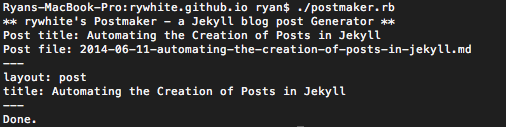
<p>What does it look like in action?</p>

<p><img src="/images/postmaker_run.png" alt="Postmaker in action" /></p>

<p>I’ve never written anything in Ruby before, so this was a fun chance to learn the basics of the language.</p>]]></content><author><name>beachwood23</name></author><summary type="html"><![CDATA[I like to automate things that are a bit tedious. So, I’ve automated a slightly tedious thing and probably put more time into than will pay off. But perhaps it might help someone else.]]></summary></entry><entry><title type="html">The roots of Native American repression in the U.S.</title><link href="http://beachwood23.com/2014/05/22/indian-country-history.html" rel="alternate" type="text/html" title="The roots of Native American repression in the U.S." /><published>2014-05-22T00:00:00+00:00</published><updated>2014-05-22T00:00:00+00:00</updated><id>http://beachwood23.com/2014/05/22/indian-country-history</id><content type="html" xml:base="http://beachwood23.com/2014/05/22/indian-country-history.html"><![CDATA[<p>I completed a research paper on the issues of modern Native American Country and how those issues came to be. I’ve edited it to be more palatable, and the following article is the result.</p>

<p>The modern-day American Indian tribe is commonly alienated and misunderstood by American-culture at-large. Other than issues raised by sports teams’s mascots, few Indian issues are discussed or mentioned. The larger problems of economic dependence, high unemployment, and poverty are ignored. No prominent figureheads for the Indians exist in national media, so awareness of these issues is often low. While troubling, this situation is neither surprising nor contemporary. America’s approach to dealing with Indian tribes has been one of ignorance and disrespect, not of understanding and civility. Part of this is because of a lack of education with respect to Indian history and culture. Most Americans might still believe that poverty is simply “how Indians are supposed to live,” and that Indians have always been a communal culture that reject private property. These ideas have not been rejected in mainstream thinking, and continue to see credence.  The root of these Indian issues is not modern or contemporary, but established within colonial-period law – laws that, if they were to be properly examined in present-day, would be condemned as racist, religiously discriminant, and autocratic. These laws were strongly influenced by anachronistic Christian thinking, such as 15th century papal bulls. Prior to their entrance into formal law, the same Christian thinking was employed by early American colonists.</p>

<p>Before investigating the Christian justifications of European colonists, it would be helpful to consider the Indian perception of land rights and private property. One of the major misconceptions of our contemporary popular beliefs on Indian culture is that they have a different understanding of property rights than Westerners. We see this being used as an excuse as to how Indians allowed themselves to be taken advantage of during the colonial period. The thinking goes that if Indians properly recognized how colonial Americans saw property rights, then they would have been able to defend their tribes and their land better, make smarter deals and business decisions with the colonials, and perhaps even profit from the new trade. Not only is this line of thinking naïve, it represents an ignorance towards the historical culture of Indians pre-European contact. Indians in fact understood perfectly well the idea of private property, and “all Indian assets except for land were privately owned, and truly communal property was scant among Indians”. Even land, however, was considered tribal property, not to be shared between separate tribes.</p>

<p>One way this evidence of understanding manifests is in tribal treatment of agricultural products. Almost all Indian tribes were primarily agricultural prior to European contact, and so had extensive legal systems that dealt with the product of agriculture. These systems included property rights that protected any productions and assets that individuals and families might create, even on the tribal “communal” land. Wealthy and large Indian families had rights to farm more land than smaller, poorer families. Farming rights were even passed down after generations. Again, these private usufructuary rights were held by private parties, despite the “communal” ownership of the land itself.</p>

<p>Not only were property rights respected within Indian tribes, but so were the ideas of entrepreneurship and personal wealth. Wealthy Indian families took pride in being able to throw lavish feasts, called “potlatches,” that helped their family gain fame and social standing. In light of this, the Western misunderstanding of Indian property rights becomes more and more confusing. Miller suggests that this was a “purposeful strategy in which Euro-Americans chose to ignore Indian property rights and economic abilities because they wanted to justify taking those rights and assets for themselves”. This does seem far more likely, because even if ownership of land was truly “communal,” with no idea of private property outside of a tribe’s ownership, the actions taken by colonialists are not justified. The actions simply change from conquest over an Indian person to a conquest over an Indian tribe. As such, the Western understanding of Indian property rights is clearly flawed. There is still a gap in the thinking, one that must be filled with a proper justification for taking tribal lands.</p>

<p>At first, justifications by American colonists were weak and unsatisfying. One popular method of reasoning was that since Genesis 1:28 commands Christians to “be fruitful, and multiply, and replenish the earth, and subdue it,” colonials had a God-given right to the land. Indians were seen as savages, capable of neither replenishing the earth nor subduing it. The colonists, of course, overlooked the fact that Indians had already subdued the land, by engaging in extensive agriculture to produce the majority of their diet. Facts such as these did not cross the mind of the new Americans, who were desperately searching for whatever justifications they could muster. Christianity provided a safe backdrop, against which all arguments became moot; who could dissent with God? This attitude became dominant. Indeed, when Indians fought back against the intruding and presumptuous colonials, some were indignant that the Indians would dare fight to “dispossess us of the land, which the Lord our God hath given to us”. But the rough sketch of this argument still bothered some, and there was no real legal basis or precedent for the domination of the Indians.</p>

<p>Finally, the justification was completed in the 1823 Supreme Court case of Johnson v. M’Intosh. In this case, Chief Justice Marshall wrote in his opinion for the unanimous court that America had power of dominion over the lands of Native Americans, and that, by being discovered, Indians had lost their rights to complete sovereignty as independent nations. This power of dominion was acquired from Great Britain when the United States declared their independence in 1776. Of course, Marshall tried to frame the argument’s language in a way that ignored its inherent religious bias, but by tracing the legal precedent used by Marshall to its roots, the nature of the argument is exposed. In his argument, Marshall cited the English charter of John Cabot the explorer. That charter authorized Cabot take possession of any lands “notwithstanding the occupancy of the natives, who were heathens,” but also to “admit the prior title of any Christian people who may have made a previous discovery.” That English charter, in turn, was justified by the archaic “Christian Law of Nations,” which asserted that Christian nations have an inherent divine right to claim absolute title and ultimate authority over newly discovered non-Christian inhabitants and their lands (although, the discoverer must concede to the prior title of any Christians who discovered the land first). This argument still seems flawed, and without basis, until the very root is reached: the 1452 papal bull by Pope Nicholas V that declared war against “all non-Christians throughout the world, and specifically sanctioning and promoting the conquest, colonization, and exploitation of non-Christian nations and their territories”. A decree as powerful and expansive as this bull could be used to justify thousands of atrocities, and this is what happened. Among other things, this papal privilege was expressly used by Portugal to traffic in African slaves, and later by Spain’s Christopher Columbus in his travels to the American Caribbean.</p>

<p>So, in following the relevant precedents of the 1823 court decision, the religious bias becomes incredibly conspicuous. The Doctrine of Discovery, as this argument is now known, became part of United States law. Simply put, it implies that it is legally permissible to ignore any rights of indigenous heathens, as long as one acknowledges prior title claims by Christians. Church and State were kept strictly separate in almost every aspect of American law, but the Christian Doctrine of discovery was made the cornerstone of America’s policy towards Indians.</p>

<p>There was now legal precedent for any discriminatory and violent actions towards Indians.  Americans concerned with the legality of their actions could simply cite the Supreme Court decision itself and ignore the contradictory nature of the Christian-based argument. The Marshall court decision also laid the groundwork for future decisions against Indian interests, like in the 1831 case Cherokee Nation v. Georgia. The court decided that the Cherokee nation (and by implication, all Indian nations) was not fully sovereign, but rather a “domestic dependent nation”. In the same decision, the Court compared the relationship between the federal government and Indian Country to that of a “guardian” and his “ward”.</p>

<p>The Christian Doctrine of Discovery had been extended and codified into America’s policy towards Indians, and the U.S. had complete plenary power over Indian nations and tribes. This policy was used to make legal the federal governments multiple reneges on treaties entered with Indian nations. If an Indian nation is not a legitimate entity, and is domestically dependent upon the United States government, then the U.S. actually made treaties with itself, and thus has the power to negotiate with itself to change the terms of those treaties. One of the worst outcomes of the Cherokee Nation v. Georgia decision was the Indian Removal Act of 1835. Just four years after declaring all tribes to be dependent nations, the federal government forced all Indians east of the Mississippi to move west. Similarly, the General Allotment Act of 1887 divested Indians of 90 million acres of tribal land, in a blatant land-grab that used the Johnson v. M’Intosh decision to justify itself. No Christian-specific rules or doctrines had to be cited for these actions to be justified – the precedent was directly established by the Supreme Court decisions.</p>

<p>Given the history of American relations with Indian Country, it is almost understandable how mistaken beliefs can still be held. The entirety of American Indian policy is almost built on treating Indians as inferior, initially by virtue of their heretical nature, and then, after taking away any land and assets that would allow them to be economically independent, by virtue of the dependence upon the federal government. At first glance, it can be hard to look at Indian Country and see any possibility of independent success, but that is a direct consequence of the absolutely horrible situation American policies have placed them. When Euro-American colonists and the modern American public wonder why the peoples they have dominated, conquered, and lorded over have fallen into poverty, it becomes an exercise in cognitive dissonance. This poverty then becomes a further justification for America as a guardian over Indian Country, saying that Indian tribes are fundamentally dependent upon the federal government. Indians have not always lived in poverty, and poverty is not the “Indian way of life,” as shown by the economically stable activities of agriculture and hunting carried out by tribes prior to colonial contact. Perhaps with non-discriminatory federal policies and less bureaucratic oversight, Indian tribes will be able to raise themselves out of poverty. This can only happen, though, if the current legal precedents with respect to Indian affairs are completely thrown out the window, and problems are judged with a fresh and contemporary legal eye.</p>

<p><strong>Works Cited</strong></p>

<ul>
  <li>
    <p>Henson, Eric C. The State of the Native Nations: Conditions under U.S. Policies of Self-determination: The Harvard Project on American Indian Economic          Development. New York: Oxford UP, 2008. Print.</p>
  </li>
  <li>
    <p>Kades, Eric. “History and Interpretation of the Great Case of Johnson v. M’Intosh.” Law and History Review 19.1 (2001): 67. William &amp; Mary Law School Scholarship Repository. Web. 6 May 2014.</p>
  </li>
  <li>
    <p>Miller, Robert J. Reservation “capitalism”: Economic Development in Indian Country. Robert J. Miller. Lincoln, NE: U of Nebraska, 2013. Print.</p>
  </li>
  <li>
    <p>Newcomb, Steve. “Five Hundred Years of Injustice:.” Five Hundred Years of Injustice. Indigenous Law Institute, n.d. Web. 07 May 2014. <a href="http://ili.nativeweb.org/sdrm_art.html">http://ili.nativeweb.org/sdrm_art.html</a>.</p>
  </li>
</ul>]]></content><author><name>beachwood23</name></author><summary type="html"><![CDATA[I completed a research paper on the issues of modern Native American Country and how those issues came to be. I’ve edited it to be more palatable, and the following article is the result.]]></summary></entry></feed>